
Habit Hero

year
2025-2026
timeframe
17 weeks
tools
Figma, Miro
Problem
The old version of HabitHero failed to provide users with personalized goal-setting options (including nutrition and food intake monitoring), contextually relevant insights that adapt to individual circumstances, or community connection features that enable local accountability partnerships and shared goal participation. This results in users feeling unsupported, isolated, and unable to track what truly matters to them—ultimately causing frustration, loss of motivation, and failure to achieve desired outcomes.
Overview
HabitHero is a habit-building app. I led the redesign of its progress-tracking experience to deliver clearer feedback, adaptive goals, and more meaningful insights that support long-term habit formation.
00
Review of existing website
The existing app was critically analysed using Nielsen's Ten Usability Heuristics, Rams' Ten Principles of Good Design, and Gestalt Principles — frameworks that guided the critique across usability, aesthetics, and overall experience. This surfaced key design strengths, pain points, and opportunities to improve clarity, consistency, and engagement, all documented as hypotheses to validate through user research.


01
research methods
Interview
sample size
7
User Interview
A mix of physically active users and those who wanted to be but struggled to maintain consistency were interviewed. The first group revealed what's working and where there's room to improve; the second surfaced the real pain points behind an inactive lifestyle.

02
User Persona

03
Story Board

04
Site Map

05
Wireframing to prototyping
The design process began with low-fidelity wireframes, where the homepage concept, main dashboard layout, progress visualization, calorie intake tracking, and rewards features were explored. The primary objective was to create a minimal, clutter-free, and intuitive interface that enables users to complete tasks effectively and efficiently. Based on iterative refinements, the design evolved into a mid-fidelity prototype with clearer navigation, improved structure, and stronger visual hierarchy, which was then used for moderated usability testing.
low fidelity wireframes

mid fidelity prototype - homepage

mid fidelity prototype - activity page

06
Usability Test
The purpose was to evaluate whether Habit Hero’s redesignedcalorie intake progress tracking and rewards system effectively address common user challenges related to goal monitoring, motivation, and long-term engagement

07
Usability Test Findings
The evaluation was conducted through moderated usability testing sessions using a think-aloud protocol. Six participants aged 30–50 took part in sessions that ran 15–30 minutes each.

Usability testing confirmed strong core functionality, with no critical failures. Identified issues affecting navigation clarity, feature discoverability, and feedback visibility were addressed to improve efficiency, reduce hesitation, and strengthen engagement.
08
Hifidelity Design
I developed a high-fidelity design system and prototype that translated research insights into a cohesive visual experience. All app screens were designed with consistent typography, colour, and iconography — balancing a bold, energetic aesthetic with clarity and ease of use.
Interactive elements, including a points-based rewards system and activity tracking, make building healthy habits feel motivating rather than mundane. Gamification features such as daily goal tracking and redeemable points encourage momentum and sustained engagement. All components were built with consistent sizing, spacing, and alignment to deliver a polished, purposeful, and rewarding user experience.
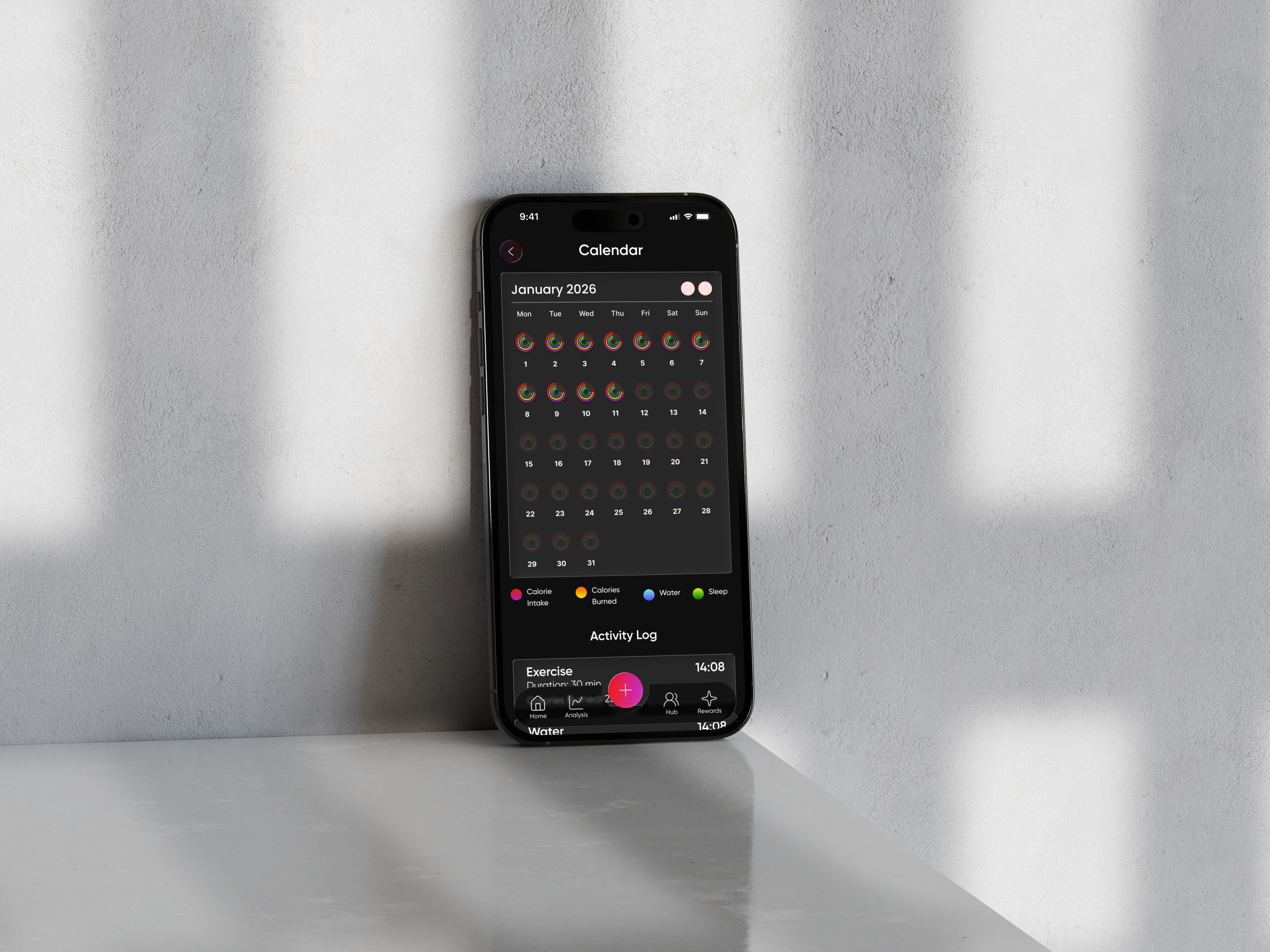
Calendar screen gives users a historical view of their health activity — combining calendar visualisation with daily logs to track consistency and review past performance.

Analysis – Calorie Intake screen breaks down daily nutrition in detail and provide AI driven personalised tips, helping users understand calorie consumption, macronutrient distribution, and progress toward their dietary goals.

The Add/Log Meal screen offers multiple logging options, making it quick and easy for users to record meals. For the MVP, calorie intake logging is the focus.
09
outcome
A seamless AI-powered habit building experience that combines guidance, accountability, and progress tracking into one intuitive product.
Conclusion
This project reinforced that successful habit formation is less about adding more features and more about reducing friction. Designing for consistency meant prioritizing familiar interactions, clear feedback, contextual guidance, and meaningful accountability. If I were to continue developing Habit Hero, I would explore AI-driven personalization to create adaptive experiences and expand the community hub to strengthen social accountability.


.say hello